January 2026
Ranjan Roy
Liton Chakraborty
Surajit Haldar
Byomkesh Talukder
Mou Leong Tan
Sajib Roy
Simul Bhuiyan
Ngai Weng Chan
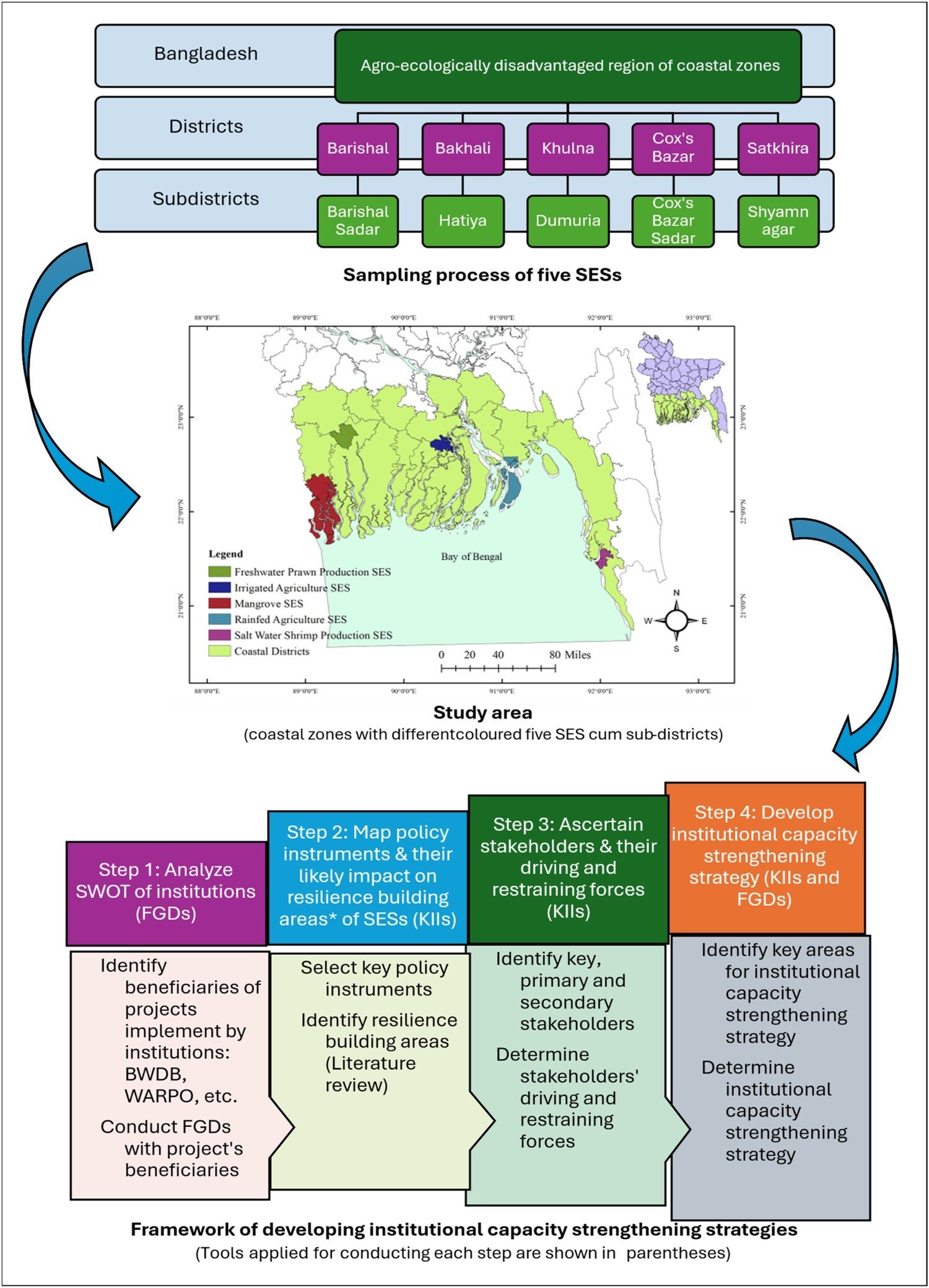
Bangladesh’s coastal socio-ecological systems face severe climate-related stresses, including sea-level rise, cyclones, salinity intrusion, and flooding. Strengthening resilience in these systems depends on institutional capacity, yet national policies are rarely informed by evidence on how institutions operate at local levels. This study presents an empirically grounded, multi-scalar assessment of institutional strengths, weaknesses, opportunities, and threats across five coastal socio-ecological systems. A four-step approach was applied: (i) strengths, weaknesses, opportunities, and threats analysis using focus group discussions and key informant interviews; (ii) review of relevant policy instruments; (iii) stakeholder analysis; and (iv) co-development of institutional strategies. The analysis combined qualitative thematic coding, frequency-based assessment, and validation through multi-stakeholder workshops. Results identify persistent challenges, including bureaucratic delays, weak inter-agency coordination, limited technical capacity, and low local participation, alongside opportunities arising from existing policy frameworks and community social capital. Based on these findings, the study outlines three broad pathways and six strategies to strengthen institutional capacity, including integrated coastal zone management, resilience-based natural resource management, mangrove restoration, climate-resilient infrastructure investment, regulatory enforcement, and pro-poor economic development. Political-economy constraints, such as elite capture and fragmented mandates, remain key barriers. Overall, the study offers context-specific guidance to improve governance and climate resilience in coastal Bangladesh.