December 2025
Liton Chakraborty
Hirsa Taherimashhadi
Jason Thistlethwaite
Daniel Henstra
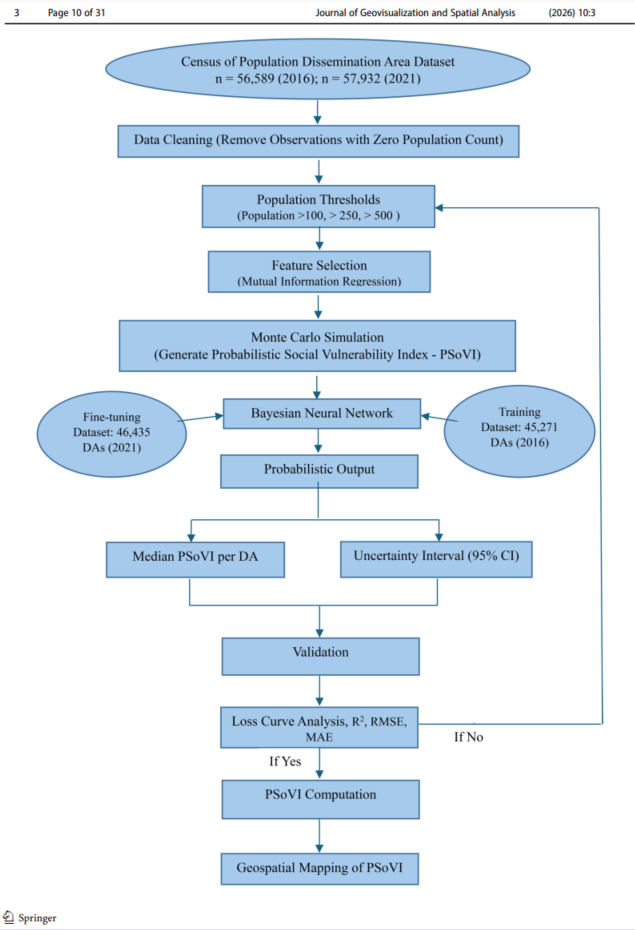
Deterministic social vulnerability indices rarely quantify uncertainty, limiting their usefulness for climate risk governance. This study develops a probabilistic framework for assessing spatio-temporal vulnerability to flood hazards in Canada using a Monte Carlo-Bayesian Neural Network model. The approach propagates input and model uncertainty to generate Probabilistic Social Vulnerability Index (PSoVI) scores with credible intervals, improving transparency and interpretive reliability. Mutual information regression was used to select 15 influential indicators from 27 census-derived socioeconomic, demographic, housing, and cultural variables. The probabilistic framework demonstrated strong predictive performance and outperformed conventional approaches. PSoVI maps reveal fine-scale heterogeneity in urban and rural contexts and highlight elevated vulnerability among structurally marginalized populations, including recent immigrants and visible minorities. Indicator effects point to the importance of housing inadequacy, income insecurity, language barriers, and lone-parent households. Multiscale analysis shows that vulnerability patterns evident at the dissemination area and census tract levels are substantially obscured at coarser units, underscoring the need for high-resolution assessment. Validation against the Canadian Index of Social Vulnerability and uncertainty visualizations indicates that areas with fewer than 250 residents yield unstable estimates, establishing a practical reliability threshold for national-scale assessment. To demonstrate applied relevance, PSoVI outputs are integrated with JBA Risk Management’s 100-year flood hazard maps for Canada and 2021 DMTI CanMap residential address points to quantify property-level flood exposure. A bivariate local indicator of spatial association identifies high-resolution flood risk hotspots and distinguishes high-confidence vulnerability from areas where uncertainty warrants caution. The framework enables probabilistic monitoring, uncertainty-aware prioritization, and transferable applications to other hazards and regions.